For a more nuanced set of immigration reasons than I prefer to explain here, my family has to leave the country where we currently live every four months. Russell and I normally have enough work trips to get the required in and out stamps in our passports to keep us within the bounds of the law, but there comes a point once or twice a year when our daughters’ declining legality in-country lines up with a three-day weekend and we take a quick family trip across whatever border is cheapest at the moment.
This weekend it was Spain.
Brene Brown says that shame can’t survive being brought out into the open and I’ve realized that my comfort with talking freely about everything from anxiety and marriage counseling to typhoid and hemorrhoids is more self-disclosure than real vulnerability. But if the conversation moves to how well I still speak such and such language or how comfortable I would be with hosting friends from the refugee camp in the grand house I live in now, or take your pick of any other number of identity bruises and self-doubt grazes, and I feel a sour twisting in my stomach (not unlike typhoid).
One of these places that feels hard for me to talk about is how much we get to travel. Have to travel, yes. But, get to. I mean, honestly, who gets to live like this?
Granted, when the slightly sketch local airline sends out an email saying the flight is delayed by four hours (very typical) only to announce 30 minutes before boarding that the flight is back on time sending us panic dashing through midday traffic and over closed ticketing counters and past ticked off immigration officials (muttering new-to-me Arabic vocab under their breath) in order to be the dead-last people to board the plane by the skin of our teeth, it’s not glamorous. And when the 8:30pm flight home is predictably eased back to 1 AM on a school night and kids are doing homework on the terminal floor, it’s doesn’t feel anything like vacation.
But. Throwing a few changes of clothes and a pair of good walking shoes into a carry-on and casually slipping from one world into another is every bit as magical as you might think, almost more so now because it happens with so little fanfare, so little prep. Our lives are full and complex enough that trips like this tend to sneak up on us. One minute you are deep in a zoom meeting, loading the dishwasher, conjugating verbs in a language lesson, praying in traffic. The next it’s like you’ve tripped and fallen through a wardrobe and woken up trailing slowly behind your daughters as they walk down cobblestones at twilight, pointing towards a particularly unique spire on an old church to the background hum of an unfamiliar language.

***
Every week for the past five months I have been meeting with a woman named Amalie. Actually, I’ve been meeting with Amalie far longer than that but we’ve only recently began moving through the Spiritual Exercises of Ignatius. Amalie is German, married to a Canadian, lives in England and worked for over 13 years in Yemen. She is a trained spiritual director and with her unique life experiences and insights, has been an invaluable conversation partner and witness to my walk with God in the past few years. (Early on in our relationship she mentioned the frog-in-the-pot experience of fixing a cup of tea while noticing your roof vibrate due to bombs falling on nearby towns, and I thought, now this is someone with whom I can unpack my questions for God.)
The Spiritual Exercises have been a powerful experience for me (no worries if you don’t know what those are. I didn’t either until not that long ago. This is a book I am using and highly recommend.) It’s not rocket science or magic or mind-bending theology. Just a simple but dedicated practice of prayer and meditation each day. But it has pulled me in. Even in the utter privacy of my own interior reflections, I have felt the well-worn paths of the saints who have gone before me. In the untouched landscapes of my soul, there are mysterious grooves, handholds, fingerprints left by other pray-ers. This is an ancient way we walk. Even in the solitude of prayer, there is community.
All that to say, when I realized how close we were to the mountains where Ignatius came to faith and wrote the Spiritual Exercises, I cast my vote in the family meeting for Spain.
***
To get to the Monastery of Montserrat you must take a train out of Barcelona. It’s about an hour and a half journey, the roofs and spires of the city progressively fading into fields and hills. We stepped from the train almost directly into a yellow cable car that slowly threaded us high into the domed mountains towering around us. There we were, a dozen tourists (pilgrims?), dangling together in gentle ascent, the bald mountains crowded around us like faceless heads of Easter Island. At that hour, clouds still lurked around the peaks like smoke.
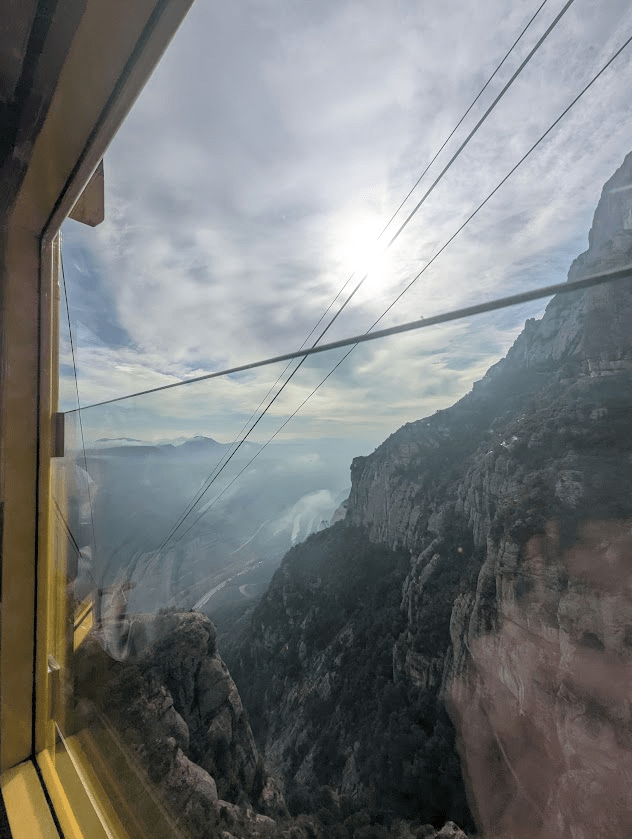
The story goes that Ignatius came to the Monastery by donkey in 1522, still young and naïve but passionate and hungry for God. He had met a Muslim Moor en route and they had talked at length about spiritual matters. While they found common ground in many things, they also met with significant disagreement, specifically in regards to Mary, mother of God. The Moor went on his way. Ignatius fell behind enraged and wrestling with a compulsion to avenge Mary’s honor by chasing down and killing the Moor. After a brief prayer he chose to let his donkey decide the matter. When he came to a fork in the road he gave the donkey free rein. If the donkey took the road the Muslim man had traveled, Ignatius would ride after him and take his life. If the donkey took the other road, Ignatius would move on his own way in peace.
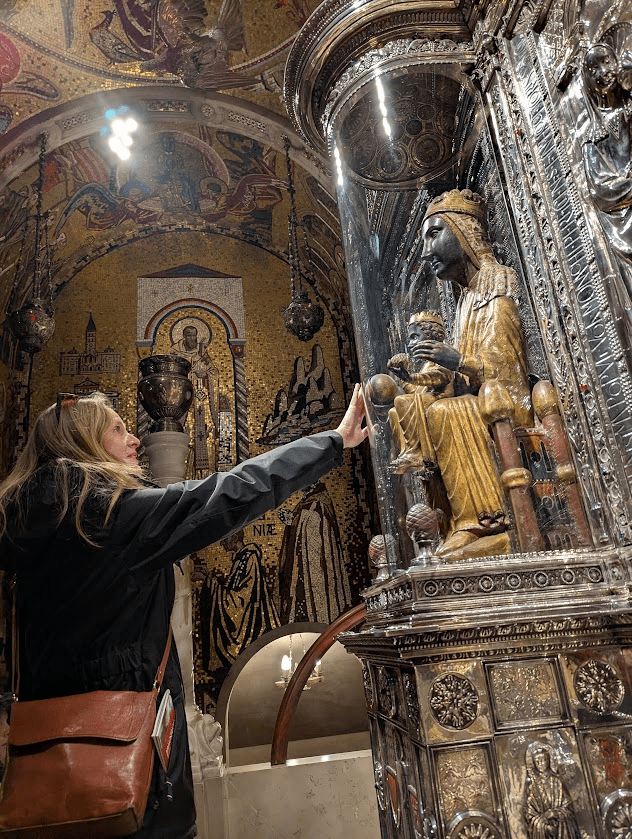
As biblical witness also attests, God seems to have no problem allowing animals to be his mouthpiece. The donkey did not follow the Moor. Ignatius carried on to the monastery of Montserrat and stayed for several days in prayer, confession and meditation. On his last night in the monastery, he spent all night in vigil at La Moreneta, a wooden statue of the Madonna and Child that mythoogy says dates back to the 800s, her face mysteriously darkened by age and candle smoke. In the morning, he hung his sword on the shrine, traded his fine clothes with a local beggar and committed his life fully to God.
I want and I choose what better leads to God’s deepening his life in me.*

***
Going in to see a Catholic icon over a thousand years old in a monastery many hundreds of years old in the mountains of Spain feels very much like – well, going to see a Catholic icon in a monastery in the mountains of Spain, actually. Quiet. Ornate. Engorged with symbolism. Both familiar and otherworldly all at once. Beautiful and garish.
Like in so many other anchor points of religion, I felt such a gravity pushing and pulling me, like both poles of a magnet working on me at once. How starved for God we humans have always been to make such bastions of our faiths. We have created such beautiful tools to reach him. Such deadly, beautiful tools. Cathedrals, Kaabas, prayer mats and pews, rituals, rites and rules. Culture and clothing and body language. Everything we can to mark what is good and true and real and in. As though that was ever our job to begin with.
And what humility he has – what fathomless grace – to allow himself to be found in these tools we craft again and again. Like languages we confuse for the real thing. Words struggling to contain something more.
I cringed against the glare of light off of some of the haunting statues we passed on our climb up to La Moreneta. But when I ran my palm against the smooth wood of the orb she held outstretched, like tens of thousands of pilgrims before me, her child balanced peacefully in her lap, I cried. I’m not sure why. Just like I wince in my headscarf when I cannot pass into the main prayer room of the grand mosque because I am a woman, but get goosebumps when everyone kneels together, shoulder to shoulder in perfect unity. Just like when I roll my eyes at the smoke and lights behind the praise team dressed as though for a photoshoot in a wheat field, but weep through every single verse of “Waymaker”.
Believe me, dear woman, he says to me. The time is coming – in fact – it’s here now – when it will no longer matter whether you worship on this mountain or that mountain. The Father is looking for those who will worship in spirit and truth. For God is Spirit, so those who seek him must find him in that way.*
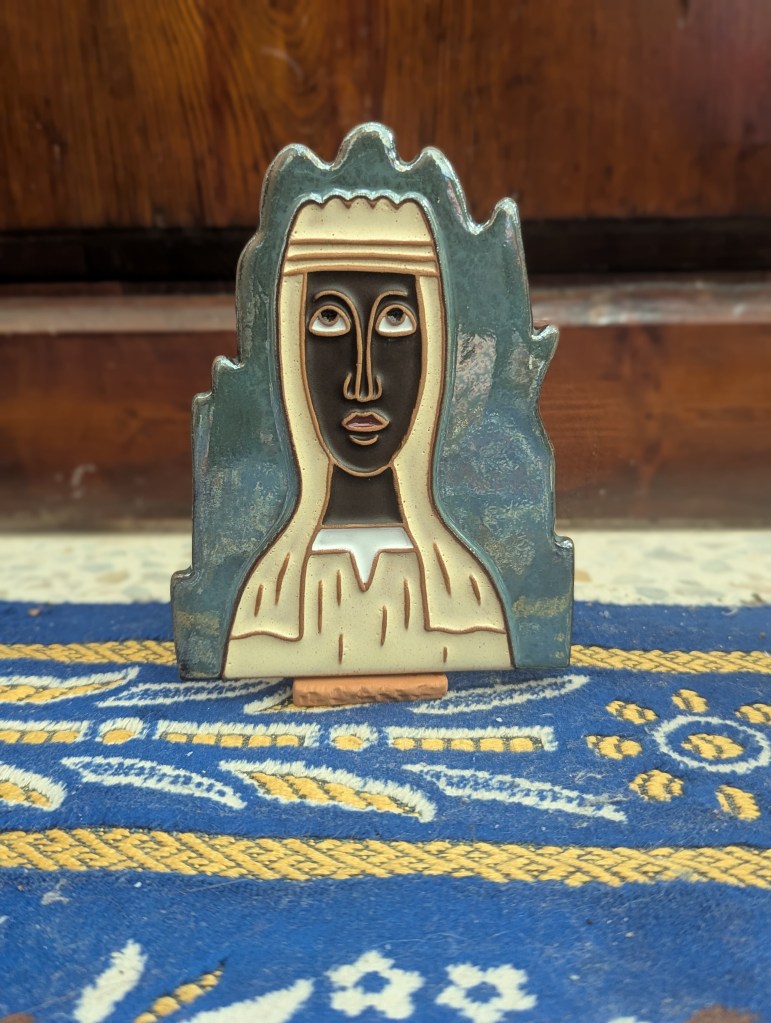
I didn’t leave anything physical behind with Mary, though I chuckled thinking how my Marian theology probably aligns more closely with the Moor’s than with Saint Ignatius. But I still bought a terracotta piece painted with her dark face. It sits now not far from my prayer mat. The one I bought outside the Ghaddafi mosque in Uganda many years ago. The mat is dusty with sage ash from the incense I burn when I pray. Each one pulls me in in some small way. Pushes me back out. Moves me along in this ebb and flow of prayer we are called to live without ceasing.
Religions. Tools. Languages.
Things we have to do. Things we get to do.
Mountains.
Spirit and Truth.
Full of chorizo and Spanish wine, I am now back in the land of lamb and rosewater. (My youngest is famous in family lore for having once asked when we landed in a new country and asking in all innoccence before breakfast, “Papa, is this a bacon country?” We observe most cultural norms in our travels. I’m not saying we don’t have our favorites). Ramadan will begin soon. As will lent.
May the Father continue to find what he is looking for in each of us this week. And may we find him, in all the shocking places he is willing to be found.
*Ignatius’ “Principle and Foundation”, comtemporary tradition; John 4
 Far From My Mountain