Of Boars, Beth Moore, and Solo-parenting

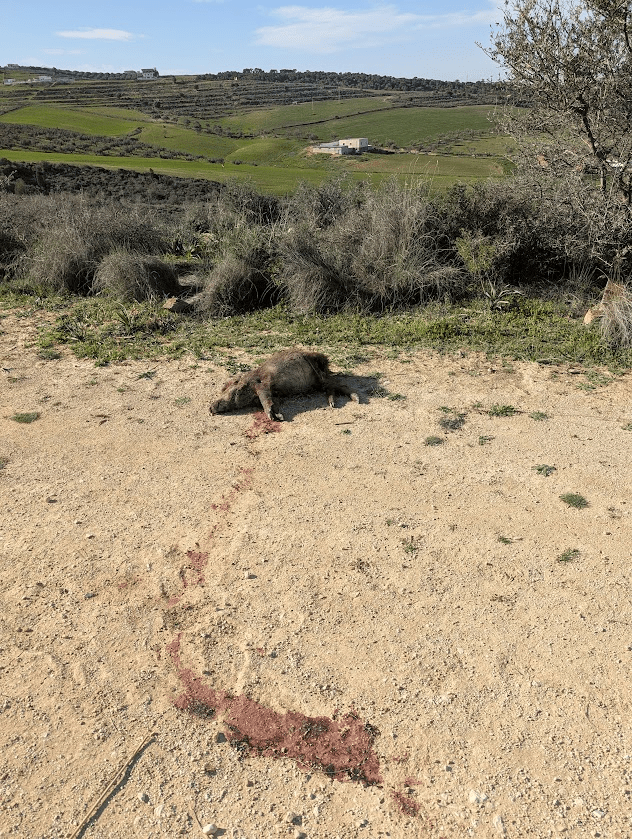
What’s the strangest thing I have done this past week, you ask? I was going to say it’s actually been a pretty average week, but then I remembered the moment where I was crying over Beth Moore’s memoirs playing in my earbuds on Audible while surveying the bloody remains of a wild boar I stumbled across on my running trails, so I’m going to have to go with that. Stooped hands on knees to catch my breath on an isolated trail next to a dead hog in a country where no one eats pork while Beth Moore’s southern drawl lilted in my ears. Just a regular Thursday morning, y’all.

 I say “stumbled across” but really I had been following the sandy splashes of blood on the trail for well over a kilometer and glimpsed the shotgun casing in the brush so I wasn’t completely shocked. Having seen the huge black beasts rooting through garbage piles dumped near the trailhead on dawn runs before, I was actually relieved to see it bloated and on its back. Childhood memories of Old Yeller being cut to pieces by a boar had had me keeping my eyes on decent climbing trees as I picked my way down the path, ready for some enraged and injured pig to explode out of the bushes at any moment. But as I turned a bend on the backside of an olive grove, there it lay.
The Beth Moore memoirs are also a bit of a surprise to me having never done one of her Bible studies before and probably holding more of a bias against her than I care to admit. (Though if you had asked me for the precise nature of my prejudice I would have had a hard time answering definitively. Sometimes we are the most judgey about the things we are most like in the big scheme of things.) But a trusted friend had recommended the read and as it turns out, I have had a hard time listening while running on account of how difficult I find breathing while laughing or crying. Regardless of what you think of her (and what I think is not what I thought I thought), the woman can tell a story.  

On this particular day, I was listening to Beth describe the fallout of 2016 tweets in which she voiced her dismay at the evangelical support for our then and current president in the wake of the Access Hollywood tapes. Even though I had angry tears on my face as I listened to her powerful words while curiously circling the dead pig, I have a pretty good sense for the poetic and had to tip my hat to the symmetry of the moment before continuing on my way. But more on politics another time.  

But yes, other than that, it’s been a fairly low-key week. B’s trip back to the US has been extended by another 5 days. This is hard for the girls and I because we miss him terribly, but we hadn’t yet relaxed into fully anticipating him being home when the call was made to delay his return and so as we round the bend of one more week without him, we’ve still got a good grip on things. School mornings, zoom meetings, language lessons, homework, laundry, groceries, the usual cycle of things. Motorcycle gelato deliveries have helped.

In the moments where solo parenting for weeks on end feels hard, and also when it feels unexpectedly easy, I think of my friend Mona (not her real name). She’s just an acquaintance really. But I get messages from her most weeks. They’re never very personal, even when I gently inquire into how she’s really doing. They are mostly updates, insights into how we can be praying.

Last week marked twenty-three months since her husband was taken from her.

I met her over a year ago on the grounds of the Anglican church where we meet on Sundays. I had never seen her before. She was dressed more like a conservative Muslim woman than most women that sit in this building with the stained glass windows, and had a little girl encircling her legs. Her skin color was what Bryan and I sometimes refer to as “normal”, quoting an Uzbek friend who was once trying to describe a Mexican colleague (“You know, the guy who’s not white, he’s not black, he’s just – how do you say it? Well, he’s normal.”) In other words, she could have been Arab or Italian, Brazilian or Navaho, Indian or Greek. Her impeccable “Airport English” without any clues hidden in a discernable accent made it even trickier to peg her.

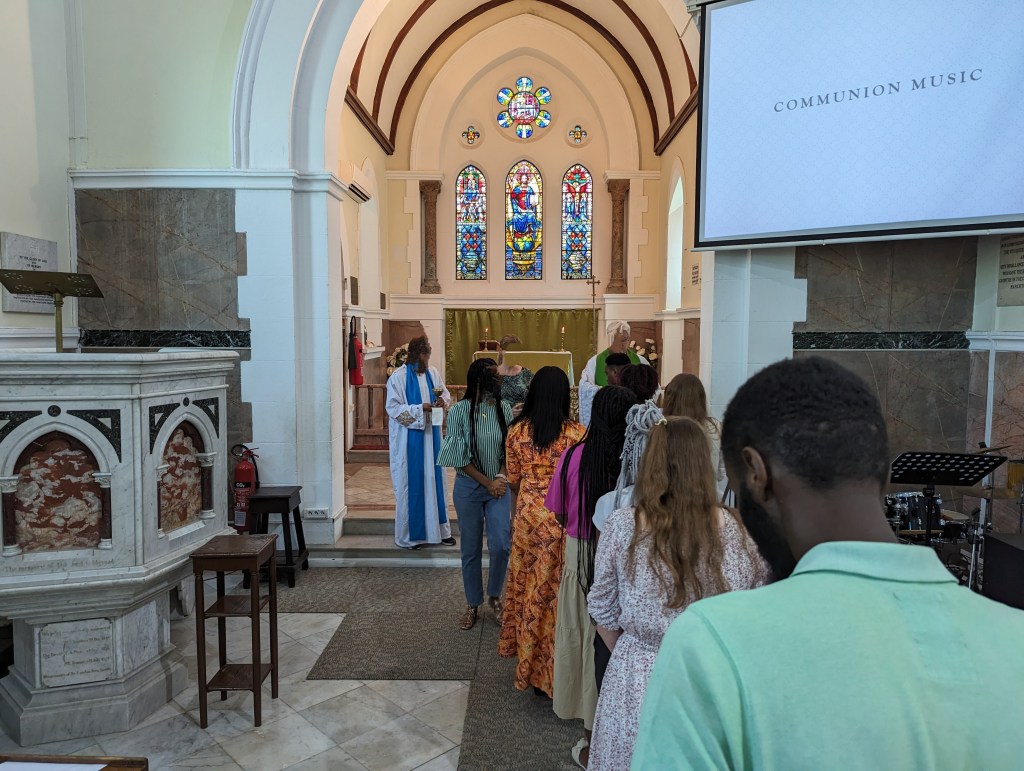
It turns out she is from the country just to the East. Most Sundays we have a number of Christ followers from this country turn up at St. George’s, in some seasons more than others. Two years ago, when there was a serious government crackdown next door, we had quite a few. Mostly young men, well dressed and quiet. Discreet, even here. Politely evasive about their stories in small talk. Where are you from? What do you do? These are surprisingly awkward questions for many of us who gather at 10:30 on Sundays mornings here, all for different reasons. All with different answers. Diplomats, refugees, “workers”, asylum seekers, locals and foreigners, legal and not so much. We worship deeply together and line up to receive the elements from the rector. The body of Christ, broken for you. The blood of Christ, the cup of salvation. Thanks be to God. And then we linger in the garden afterwards, drinking juice and talking about the weather and our kids.
It took me a few Sundays to piece together who Mona was. But when I did, it all made sickening sense. She was Faisal’s wife, the man we had been praying for for months. The man in prison across the border charged with sharing the Gospel. He and about a dozen others were arrested in March (2023). It was weeks before Mona had any communication with him from prison. Months before he even knew that his wife and baby weren’t also in prison somewhere, that they had made it across the border safely.    

Mona was ultimately only here a few months before she relocated to another country. In that time, I often found myself wrestling with how to support a sister in this situation. What do you say to the woman in the pew in front of you who is wondering if she will ever see her husband again while we sing another verse of “I Surrender All”? Surely wondering what is happening to him in the meantime. Wondering what to tell her daughter. Mona always kept her cards close to her chest. You didn’t get much access to her emotions, to the questions she surely has for God. I don’t know how much of this was personal (it only seems appropriate that one must earn the right to see those places of the heart), cultural, or just plain survival. But she always said thank you. Thank you for praying for us.

I didn’t expect to keep hearing from her when she moved, but I have been honored to stay in touch. And I am honored to ask you to join us in prayer today too as you read these words. Whether you are reading this on your phone on the other side of the Atlantic from me, on your laptop a few countries to the South of me, or somewhere altogether different far in the future from now (if God is outside of time, can prayers in the future still bless what is currently the present?) – will you pray for Mona and Faisal?

Tomorrow, February 4th, Faisal will be sentenced. As a part of the broken Body we all inhabit together, will you pray for mercy? Pray for God’s dream for the world to come, his will be done, on earth as it is in heaven. I told Mona I would ask this of you.

I’m actually preaching at St. George’s this weekend. Somewhere my grandfather is probably rolling over in his grave knowing I am reading books by Southern Baptist women and preaching at Anglican churches. And bless me, I’m almost as surprised as he is. My hope is that it will be a Sunday of joy, of celebrating the freedom God will have granted Faisal (please, God).

But regardless, we will be there together in the mess of it all. So many odd people with all our strange stories showing up in a singular time and space before fanning back out into the world. Each to the paths God has invited us on where he keeps step with us as we laugh and cry and try to breath at the same time.

Keep the faith, my friends. Even slowly and with your eyes on the bushes, keep running.

Mubarak

I didn’t expect to be freezing cold when I first heard the news of a friend dying in a bombing.

I didn’t expect it to be now, 16 years after we first moved to a warzone. If you had asked me, I would have told you that news would have most likely come when I was sitting on a rope bed under a baobab tree sweating through my long skirt while pouring tea into small glasses for the somber guests that just walked in from the camp. Or maybe I would have heard it on a warm evening in Uganda post evacuation. I would have tried to keep dinner moving along cheerfully for the girls but really my ears would be burning, piecing together the story from the Arabic phrases and long silences syphoning back and forth from where B paced in the backyard on long legs.

But as it turned out, the message of Mubarak’s death pinged on my phone just a few weeks ago, well over a full decade after we lived in the same small town, in an altogether different corner of this continent. I heard the news standing on the edge of a wheezy campfire in muddy blue jeans with new friends in light, slushy rain.

There was no snow when we went with some friends on a camping trip in December, just sleet (let’s be honest, we were glamping really. There were cabins with heat, alhamdulillah). But apparently it does snow in this part of the country occasionally. And when it does, people flock from the capital to the mountains and hire farmers to drive them around in small pickups to take in the wonder of it all. Snow on mosques minarets. I’ve never imagined such a thing.

That’s why they have peaked roofs there. A local friend told me not long ago. Because of the snow. Isn’t that funny? Roofs that aren’t flat? You should go see it sometime.

Despite the rain, we took long walks through cork forests that weekend, along with our feral tribe of children. We talked over steaming cups in smoky firelight. The people we were with are the kind you feel like you have known far longer than is true. Do you ever have the experience of suddenly remembering a dream and thinking – did I dream that last night or 30 years ago? It feels new and terribly old all at once. I sometimes suspect new dreams are made out of the substance of old dreams, so they feel familiar even when it’s the first time you experience it. Anyway, that’s how these people feel to me. New, and yet maybe having always been.

And yet when I saw Mubarak’s face on my phone (it was an old picture so he looked exactly as he did the last time I saw him) and read the words “WFP was bombed yesterday. Mubarak did not survive his injuries” the world suddenly felt a bit tilted. It was like parallel universes were leaking over into one another, worlds that aren’t supposed to overlap bleeding through the boundary lines. The old and new felt confused in a different way.  

I’m seeing a cold lake on a cloudy lake but hearing an Antanov buzz a white-hot sky. Two different Arabics twine into a dissonant harmony. The fire is for play and warmth, not for cooking. I’m safe and happy – it’s Christmas time. It’s December, war season. The time of year you have to be ready for anything.      

***

One of my pet peeves is people beatifying very normal sorts of people after their deaths or making out a far closer relationship than ever existed on this side of the grave. Neither B nor I had spoken to Mubarak in many years. I don’t pretend to have thought of him much since our lives had flowed down different tributaries. In fact, I was actually surprised to hear that he was still in the Sudans. A well-educated veterinary and fairly cosmopolitan man, I would have expected Mubarak to have settled into a soft NGO office in Kampala or Nairobi at this point. He always talked about Ugandan pineapples – the biggest and the best in the world. Surely he was somewhere that he could eat pineapple any time he wanted to. Surely his kids were getting older. I wouldn’t have expected him to still be “in the field”. I should have known better.

To say Mubarak saved my life is misleading, melodramatic and quite frankly, cringey. But I can’t figure out how exactly to articulate what he did do that is forever etched in my mind with a still shaky sense of gratitude and gravity. If there can be a category called “Saving One’s Life Adjacent” I’d put it there. Because without him I might have walked right back over that landmine.

I saw the landmine the morning after a hard rain. I was walking on to the plot of land where we would soon pitch our safari tent. The cement slab was laid. The latrine almost dug. I was so ready to be off the Samaritans Purse compound and finally in our own space. As I made my way across the short wet grass, a bright red velvet mite caught my attention – the kind that I used to collect in glass jars with my sister as a kid in Kenya. I stopped. And there it was. The smooth arch of the cylinder peeking up from the sandy soil. Green metal, half exposed, half buried, almost coy in its modesty. Six inches from my raised foot.

I hadn’t been in Sudan long at this point. I hadn’t heard any explosions in the background yet, or tanks in the foreground. Thanks to Peter I knew to jump to the side if I ever did ever step on a landmine and not straight up like a fool. This is in hopes the shrapnel just takes your legs and not your life. I was honestly a little bit proud to be a bearer of this kind of knowledge, and in retrospect, probably held it a bit too confidently. (Those of you who know Peter can imagine him telling this to college-kid me: The mines, they sound like water boiling if you step on it. If you hear that…, eh eh eh, you just jump to the side. To the side and then….yah, you just hope for the best. All said laughing a litte too loudly.)

I didn’t hear the sound of boiling water, only goats bleating on the side of the hill that bordered the back of our plot. The day was bright and clear, the sky massive. I confess to a microsecond of dark curiosity and for an instant my foot tingled, hungry to nudge the top edge of the metal loose from the soil. There is so much from those first few months is blurry to me now. So much I don’t remember. But I will never forget the watery rush of fear that flooded my stomach for no clear reason in that heartbeat. Pure, cold horror from the top of my head down to my still hovering toes. With shaky hands, I took a picture and backed away slowly.

But, surprisingly, the fear waned with every step I took away from the object and by the time I found Mubarak I was already half-way convinced of my own overreaction. The last thing I wanted to be was the new American woman seeing UXOs around every termite mound. The sticks that turned into snakes on the path to the latrine at night were bad enough. Mubarak, resident veterinarian on the SP compound (and expert snake killer) looked at the photo on my screen and squinted a little but otherwise had no discernible reaction. He was silent for a moment and I was preparing to be embarrassed when he handed me back my camera and said, “I’m pretty sure it’s an anti-tank mine. You shouldn’t go back on your compound until the UN can clear it.”

I’m not sure why I was so stunned, but I was. It was all still very new at this point and hard to take in. Sudan is a whole vibe. It takes a minute to get used to. There was a landmine where we were planning to put our kitchen.

“Wait, so, just to clarify. It is a landmine or it isn’t?” Like I was just confirming whether someone was or was not coming over to dinner. Mubarak looked at me seriously. “It is a mine and a big one. You guys need to alert the UN. Don’t go back to your compound until it is cleared. Do you understand?”

A few days later we all tucked behind a few sandbags several hundred feet away while a couple of Pakistani peace keepers hit the fuse on some C4 packed around the mine. Later they swept the whole compound. No other mines were found.

My memories of Mubarak beyond the landmine are relatively few. I remember him shaking his head in disgust at the NGO down the road that brought in so many kilos of dog food on their supply flights when people didn’t have enough to eat. The vet spitting on the ground and muttering, “How can you bring in food for animals when people are starving?” I remember him riding with B on Abu Sita, our ATV, to fill and haul huge barrels of water from the reservoir in Korbodi. I remember one night sitting out under the stars, eating rice and beans off of flimsy plastic plates and a strange sound behind us that caused Mubarak to shush us all with a single gesture and then glaze over with intense listening. A dragonfly the size of my face had become trapped in the rain gutter in the building just behind us, making a thrumming noise, a quiet sound very close by that sounded deceptively like a loud noise very far away. When we discovered this, Mubarak laughed but his eyes were bright. It sounded like Nuba Mountains drums. It sounded like home.

We had just over two years in that place with Mubarak and so many others. Those were some of the most raw and exhilarating days of my life. Everything felt more intense, like a drug – the thunderstorms, the color green, the laughter, the malaria, the dreams.

Those years feel like a lifetime ago. Like an old dream, not a new one. But in the old dream, Mubarak went on to live a long life, to see his kids graduate from college, to raise a few cows on a small farm in a country far away from war. Mubarak was one of the many Sudanese who taught us what to do if the planes ever flew over us. How to quickly size up the safest place if you don’t have a foxhole, how to lie down, when it was safe to get up. It feels endlessly shocking to me that, in the end, he died in a bomb dropped from a plane. Why was he still there – there in that town, there in that spot? Why didn’t he do the things he taught us to do? He knew what an Antanov sounded like. He knew where to go.

It feels like the heavy-handed ending of a poorly written novel. Incongruous. Ironic in a tasteless way.

I have a bad habit of gently trying to keep my life within the boundaries of each season. There’s been so many of them. In my mind, it’s just as well for each to enjoy the freedom of their own chapter, their own world unaffected by the mess of the other parts. Worlds colliding has always been disorienting for me. But, go figure, these parts of me, like my dreams, continue to resist easy timestamps and categories.

The past keeps washing up all over my present. Joy sloshes all over my grief. The smell of bakhur or the taste or watermelon or the way one of my daughters looks when reading a book are all threads pulling in tighter, weaving what has beautifully been with what gloriously is and will mysteriously yet be. My own stories keep getting underfoot and tripping me in to focus on the thing lying right there in front of me, waiting to be noticed.

It’s Monday, here in the upstairs room of my house that has a roof you could host guests on if you wanted to. It’s warming up outside and I hear my neighbor’s dog. I have emails waiting to be written, a language lesson to prepare for (this Arabic now, not that one). It will be time to go pick up the kids from school here in just a bit. I don’t recognize the plane that just passed overhead by its sound. But I always hear them.

Boukornine

This time of year, the call to prayer echoes out across the city just a few minutes before my alarm goes off. The dark is still deep and quiet and the greatness of God echoes out from a thousand minarets with no competition from traffic or birds or music. We’re lucky to have a neighborhood mosque that plays a quite resonate recording of the muezzin, nothing too nasal or jarring. It’s a beautiful way to be pulled out of foggy dreams or freed from the confines of a restless night.

Another day is starting. We are still here. Pray without ceasing. Wake up, there are hungry things to feed.

Balti is usually the hungriest of those things in our house. The small orange bell on his collar tinkles politely as he pads into our room, purring. Never in a million years did I think I would reach a point of condoning the presence of an animal in our house overnight. (A couple days ago as we crawled in bed, B said “This is the first night in our entire married life that we’ve gone to bed with animal in the house,” and I almost said something about the years we spent pulling rats off of sticky traps and swatting at bats with large kitchen spatulas but since he did the majority of the heavy lifting in that department back then, I left it alone).

After three of my four decades spent on this continent, it still feels weird to have a mammal we can neither eat nor milk living in such close proximity to us. But it’s been in the low 40s the past few nights. And rainy. And he makes us happy. And, I’m realizing that “this continent” is a phrase that has even far less meaning as a cohesive idea than I even realized – it’s not uncommon to see old men welcoming street cats onto their laps at sidewalk cafes and some of my neighbors walk around with slices of turkey jambon to feed the gangs of feral cats that rule the streets. Yet one more reminder that “normal” is a fairly useless concept 90% of the time.

B usually takes the girls to school in the morning, but he just landed in New Orleans for a quick trip back to help family. In fact, as the girls were brushing their teeth and I was pouring milk in my coffee I got his text message: “Speaking Arabic with my Mauritanian Lyft driver!” Imagining my jetlagged husband chatting about global politics in Arabic while crossing the Lake Pontchartrain causeway makes me feel like my brain is bleeding. But. It also makes me smile. There are two happy men in that taxi right now.

We shuffle out the door with backpacks, coats, lunchboxes, trumpets. Balti slithers through our ankles, and disappears around the corner. He likes to sit on the jasmine shrub in the back where there is sunshine and birds. While I lock up, the girls have their chins pointed upward and are exhaling vigorously. They remind me of me at this age, weird TCKs, – still not over the marvel of living somewhere that breath is occasionally visible.

Traffic is already picking up when we ease around the rond-point and on to the main road to school. The sun hasn’t yet crested Jebel Boukornine’s bulky shoulders; the purple mountain is perfectly outlined against the citrus sky, it’s two peaks like a fish’s open mouth pointing heavenward. When we first moved here I was mesmerized by that mountain. I couldn’t believe there were people who got to see it every single day on their commute. And that I was now one of those people. I remember loving it, but also feeling like it wasn’t mine to love. Like I was a passing admirer but had no real right to such a mountain. It’s been two and a half years now. And slowly, I’m feeling a touch more possessive every day.

The girls’ school is off of a busy highway and the dog-leg to get all the way into the neighborhood is a nightmare in morning traffic. So, like many other parents, I ease to the right with my hazards on and sidle up as close to the sidewalk as possible and stop. Traffic liquefies around us and lurches slowly by. The man in a suit sipping black coffee from a small glass teacup. The woman in the blue hijab putting on mascara while honking at the taxi that just cut her off. An old man in a sheshea drives the taxi and he waves his hand apologetically at her, ash falling from the cigarette between his fingers to the road below. The girls scramble out like long legged camels weighed down by books and snacks. Their friends are waving as they also arrive with happy sleepy eyes. Stooped last I-love-yous and goodbyes and have-a-good-days and then a terse honk behind me. Doors slam shut and they are off. I ease back into traffic, nodding in acknowledgement to the driver who lets me back in. His small white truck is packed cab-high with crates of bright orange tangerines. I glance in the rearview mirror as I head off. I see three sisters in blue school uniforms greeting the guard and then disappearing into the school walls.     

The First Year

Those were the nights we had dreamed of –

lying awake on my grandmother’s quilt,

fingers and ankles intertwined around

the nursing baby, listening to her heartbeat

and the bark and hiss and whirl of the unfurling outside.

.

We slept deeper than dreams of home, of sisters

making their way on the far side of the world, of  

safe and clean and known. Our language-blistered

minds turned three times in sunburnt cages and

flopped down, too worn to chase wild hopes.

.

Sometimes, deep below the surface of night, we woke up.

Peacekeepers had killed the music at their sandbagged parties,

and low horns at the marisa joints had blown themselves quiet.

Only the frogs and dogs sang then, mad symphony led

by a drunk tinker bird in the tree, clanking away on his anvil.

.

The ribs in our net rose and fell in a breeze we couldn’t feel

disturbing a firefly bumping about like a lost star. And those footsteps,

circling outside again and again – angel or thief, shared dream or

common flesh – we could never find them to ask which.

But we heard them move and silently wove our fringes closer.   

.

Tonight, an old air-conditioner rattles in the room and

muffled generators roar as they keep this city of dust

breathing. My grandmother’s quilt was lost long ago.

But here with you now, on the brink of dreaming,

I remember those nights we lay spellbound, wondering how long we would make it.

.

.

.

Full disclosure, this poem is a rather shamelessly modeled on Walt McDonald’s “The Middle Years”, in my mind, one of the most perfect poems ever written.


Hide and Seek on Full Moon Nights in Malindi

It’s the kind of night that makes me want to be a bat.

Warm and luminous, I feel them trace blindly

above, drunk on fruit must and space. The sky is a beach

across which they glide, ignoring the white pumice

resting in tide-striated clouds freckled faintly with glass.

.

Of course, I am here earthbound with you,

drinking rooibos from a plastic mug in the moon-bleached dark.

Neck arched and ached, I sink upwards into the night,

out beyond the margins of the present and

break surface thirty years away on a beach somewhere

.

outside of Malindi, just South of the Galana river’s

dirty mouth, suddenly sprinting with all the endurance

of a dream. My friends and I splinter across dunes, shoes

long shed as we scatter and tumble in the high noon

of a full moon, feeling every concession of the talc underfoot

.

still warm from the day now dead. We run, breath

ragged with delight as we outpace the distant voice

counting from beyond the casuarina grove. Gradually

we fade from each other to explode into stillness

in the womb of a dune, thunderous crash of distant

.

waves breaking against our ribs. Leaning back against

the sand, soft haunches of that monstrous cat, we  

stifled the terrible thrill of being hunted in silence.

The abrupt solitude always settled like a shock, the pleasure

of being alone sharp and wild. And then, as our hearts

.

slowed and the minutes evolved into epochs,

I always began to understand that I was

now the last person on earth. Or maybe

the very first. In that breathed retraction of time

I knew that if I dared climb the sand and enter again that  

.

open night, I would find a world only yet half-born

and myself newly made in it. Beyond stretched

a ferocious garden waiting to be filled and named

if only I had the courage to see and be seen.

.

But on those nights, who dared look up?

.

We could run forever then, down the snaking miles

of that beach. We ran and we buried ourselves in the

warm shadows, waiting and dreaming of what we might do

if ever we were found.

Doors

Dear daughter who glows in this marvelous space,

I must tell you a secret about this whole place.

In this room you call home where you dance and you play,

the world that you’ve known from your birth ‘till this day,

though it’s safe and its good, it is only a part.

Put your ear to the wall, and hear with your heart.

This is but a room in a palace.

.

Can you see that old door, hid behind the green chair?

Has it beckoned before? Did you know it was there?

It leads to a world that is wilder than this,

a mysterious maze that asks you to take risks.

Take a deep breath, (you might bring a candle),

and when you are ready, turn the door’s handle.

It leads to more rooms in the palace.

.

Now, once you move forward and leave known behind,

you can never be sure of just what you will find.

Some rooms will be lovely, all flooded with light.

They sparkle with fountains, deep forests with sprites.

They’re holding more treasure than you can possibly dream,

where fantasies roam and deepest hopes teem,

Joy breathes in the rooms of this palace.

.

But some doors you push open may lead to dark places,

where voices will whisper though you can’t see their faces.

Rooms full of clocks though time only stands still,

rooms full of feasts that will never quite fill,

The echoes will scare you, you won’t know what to do.

But my baby, I promise, the way out is just through.

Fear lurks in the rooms of this palace.

.

But my child you should know, this room here will grow small.

You can’t stay forever, the other doors call.

So go explore and discover the beyond and above,

And remember this whole place is haunted with love.

And if some far day you’re led back to this room,

back to your beginning, you’ll see it’s grown too.

So follow the footprints, blow on the embers,

Dance in the ballrooms, and always remember

You were born to live in this palace.

To My Mother, Upon Losing Her Voice

Someone once said that silence is God’s native tongue,

so it’s just as well you have always been so good at learning languages.

But there’s no guide in this new world, is there?

No grammar to consult, no friendly neighbor with whom to practice.

Only deeper forays into the incomprehensible land,

exploring. No map to remember, no scaffolding or compass,

only surrender.

.

In that thrumming space, may you roam ever nearer

the deepest quiet that hears your echo,

matches your breathing breath for breath.

Look for the lightest of notes sketched in the margins,

arrows etched in the stone, signs of life from those who’ve gone before.

Take heart and move into the presence whose edges are yours.

.

Don’t pause,

follow the call that draws you out into the unplumbed fathoms.

Listen to the silence as it listens to you.

And as you go, I dare to ask,

let your fingers smudge the notes of the wordless hymn as you pass.

.

Then,

perhaps when I follow,

I will sense a way though,

and in the void, learn to sing too. 

Namesake

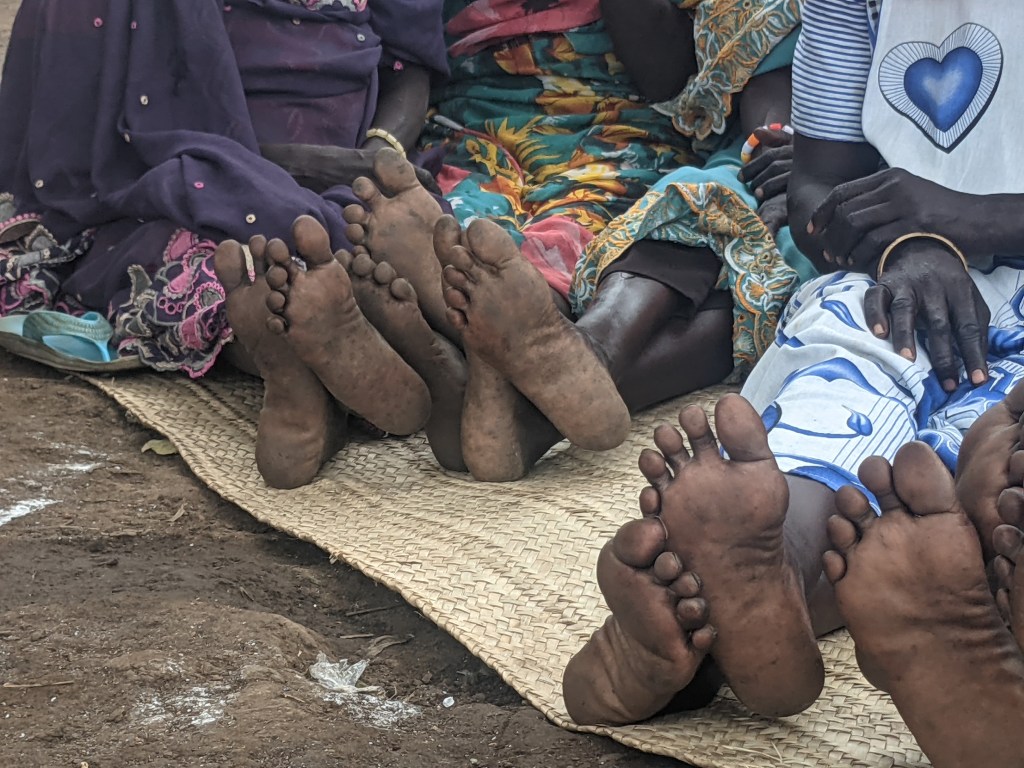
I sit on the ground with your mother and twenty more

who mourn in the threadbare shade outside the hovel

where you were born. The mats beneath us are frayed

and worn, our bare feet lean against each other. Flies hover.

.

She’s telling me of last night in words that collect

in the low places of my mind faster than I can hold,

these particulars of sorrow to be sifted later – eyes white,

spine arched, skin too hot and then too cold.

.

The old women near us are loud, their mirth a proud

obscenity jabbed in death’s face. Slurping tea, spitting in the sand,

mocking a neighbor -your grandmothers’ laughter a resistance,

cradling with insistence the waste of you.

.

You carried my strange name for a short time, a

diminutive from your language, two syllables from mine.

Perhaps it is from this tie that binds our otherwise

discordant lives that I have the courage to ask you now-

.

– had you begun to understand the light?

Was the world gathering form for you yet, the play

of color and shadow blended? In your clumsy newness, did

you sense your own boundaries, wonder where you began and ended?

.

My bones may carry me for many years more

before I lie down with you in the dirt, but in time

these questions will still be mine. My eyes will close

holding only a strained glance of what may yet be.

.

Please welcome me then,

teach me to see.

Mourning

I miss you most when I am happy.

.

When dark rain pulls itself up over of the ledge of the horizon,

heavy with thunder and the leniency of a storm,

.

When I turn down into the riot of an unfamiliar market alley,

and for a span, find myself adrift in a reef of color and sound,

.

When my firstborn sits on the kitchen counter

where I cut green peppers into long canoes,

and speaks breathless of her book,

long hair crowning her wild animal mind,

.

When the moon nudges me awake in the middle of the night,

inviting me to sit with her here on the cusp of the desert

and listen to the ocean echoing in from another life,

.

When, pausing near the sandy shadow of water

I have just flung from my basin, a bird with blue feathers

regards me with a long look I don’t understand

and I spend the rest of the day savoring the moment like a secret,

.

When walking home alone and life unexpectedly

crosses the road to embrace me, holding me by the shoulders

while she whispers the faintly slurred words, “Yes, yes! Like this…

before winking and lilting away with a song,

.

Not when I feel burdened by the sorrows of the world,

things broken, unsaid and unborn,

the roads that fade underfoot while I stand

clenching my map white-knuckled in the tall grass,

.

Not then,

.

But when I am breathed open enough to rest

in all the sweet places you are slowly leaving,

the rooms that you have only just slipped out of

and that bear your scent still,

.

Then my happiness loosens and the tears flow with abandon.

Morning Run

(I wrote this one a couple years back in the haze of baby days)

.

Daybreak fractured by the pad

of small feet.

The incessant squirming

between us in the blankets

the piercing sweet whispers,

“Mama, what’s for breakfast?”

.

Staggering into the blur

of the day

without a proper good morning.

I don’t hear

your greeting through the slop

of oatmeal, clatter

of bowls and

cries over spilt milk.

.

Folding sun-crisp laundry

tying shoelaces, slicing

apples and we speak

in half sentences:

“Please not a fever,”

“Don’t let her wake up,”

“Not today,”

“Help me.”

.

The oasis of naps

and sometimes

a few snatched moments together,

quiet conversations over a cup of tepid coffee,

the still surface of our pool so often rippled

by the impatient touch of emails,

overturned boxes of legos

dinner plans and sometimes,

just one more page of someone else’s

poems.

.

The day rolls on like a long

shallow wave

and we wash onto the evening beach,

spaghetti on the floor

the battlefield of baths, one last

dance, two songs, a story,

and before I know it,

I am falling through the guilt-

rimmed edges of

foggy prayer into deep sleep

where you watch me,

dreamless.

.

But I wanted you to know that this morning 

when I drug myself out of bed early,

when I pulled on my beaten

running shoes,

when I slipped out the back door quietly,

stretched stiffly under the baobab

and then, softly

began to run,

well, that was for you.

.

Yes, the baby weight, the

blessed solitude

the pleasant lingering buzz of endorphins,

they clamored for

their share of the offering also.

.

But, my Lord,

that last half mile,

when I had nothing left to give,

when I reached into that

place just behind

my gut and below my soul,

and scrabbled

up the sandy stretch home,

moving when I could no longer move,

and breathing when I

could no longer breath,

the fears, distractions, dreams

and frustrations

all peeling off me like old skin

and fluttering to the ground

behind me,

I was straining only for you.

.

Those were my prayers.

Sweat and bile and rasping

breath for

your sake only.

worship laid on your altar

of early morning

light.